ChatGPT Summary of Paper “Towards Robust Autonomous Grasping with Reflexes Using High-Bandwidth Sensing and Actuation”: LINK
Achieving human-like dexterity in robotic manipulation has long been a cornerstone challenge in robotics. While significant advancements have been made in planning and vision-based control, these systems often lack the speed, adaptability, and robustness needed to handle dynamic, real-world tasks. Addressing this gap, a groundbreaking reflexive manipulation system has been developed, combining high-bandwidth sensing, nimble hardware, and autonomous reflex controllers. This system delivers faster and more robust robotic grasping, paving the way for applications in cluttered and unpredictable environments.
The Challenge: The “Last Centimeter Problem”
Robotic manipulation often falters during the final stages of grasping, where environmental unpredictability and contact with objects or surroundings complicate control. Known as the “last centimeter problem,” this challenge is exacerbated by reliance on vision-based systems that struggle with occlusions and high-latency feedback. Traditional approaches often result in slow and conservative actions, making them impractical for dynamic tasks.
The Solution: Reflexive Grasping with High-Bandwidth Control
To overcome these limitations, the team developed a low-inertia, high-speed robotic arm and a reflexive grasping controller. This system combines a low-frequency, vision-based trajectory planner operating at less than 1 Hz with autonomous reflexes running at over 300 Hz. By decoupling high-level planning from low-level reactive control, the system achieves:
- Speed: Fast, high-bandwidth reflexes that handle unexpected events.
- Robustness: Reduced reliance on vision data, enabling adaptability to occlusions and dynamic changes.
- Simplified Planning: Autonomous reflexes offload complexity from high-level planners, allowing them to focus on broader tasks.
How It Works: Autonomous Reflex Architecture
The reflexive system relies on high-bandwidth sensing and actuation, enabling real-time decision-making during grasping. Key features include:
- Collision Avoidance and Contour Following: Reflexes use proximity sensors to detect nearby objects and adjust finger trajectories in real-time, ensuring smooth and adaptive movements.
- Grasp Triggering and Evaluation: The system autonomously determines when to attempt a grasp based on proximity and tactile data. After a grasp, it evaluates success using force and contact measurements.
- Re-Grasping Reflexes: When initial attempts are unsuccessful, the system plans and executes re-grasping actions, adjusting finger positions for a more secure hold.
Experimental Validation
Two experiments demonstrate the system’s capabilities:
- Expanded Grasping Capability: Reflexive grasping was tested against a baseline controller using a pick-and-place task. The reflexive controller increased the volume of successful grasps by 55% compared to the baseline, demonstrating improved robustness and adaptability.
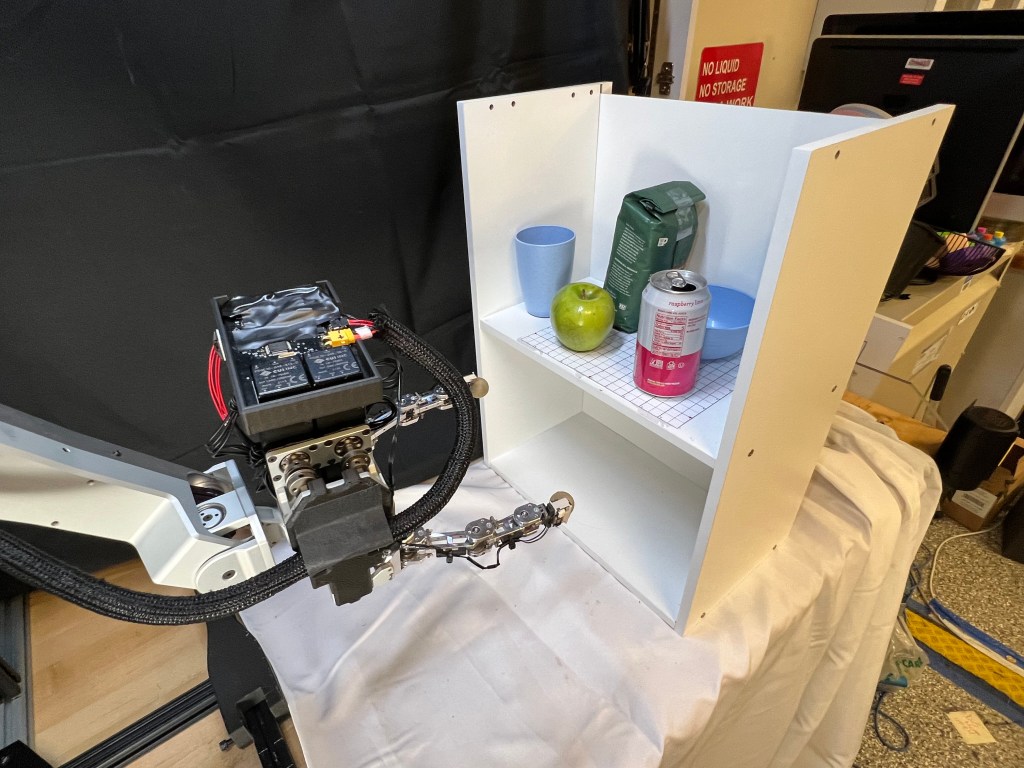
- Clutter Clearing: The system autonomously cleared a cluttered shelf of over 100 objects using a simple vision-based planner combined with reflexive control. It achieved a grasp success rate above 90%, significantly outperforming traditional methods in dynamic environments.
Impact and Future Directions
This reflexive grasping system marks a significant leap forward in robotic manipulation. By integrating high-speed reflexes with dexterous hardware, it addresses critical limitations of vision-reliant systems. Potential applications include:
- Warehouse Automation: Fast and reliable handling of diverse items.
- Disaster Response: Adaptive manipulation in cluttered and unpredictable settings.
- Assisted Living: Safe and efficient object handling in domestic environments.
Future work aims to expand the range of reflexes, enabling the system to handle softer and more irregular objects. Additionally, increasing the control frequency and refining neural networks for broader object classes will further enhance robustness and versatility.
With this innovation, robotics takes a decisive step toward human-like manipulation, unlocking new possibilities for dynamic and high-stakes applications.
 Andrew SaLoutos